folded over itself – exposição de Lola Sementsova
9 > 17 ABRIL 2026 | GALERIA BELAS-ARTES
Inaugura no dia 9 de abril, às 18h, na Galeria da Faculdade de Belas-Artes, a exposição Folded Over Itself de Lola Sementsova.
Curadoria: Alexia Alexandropoulopu
Coordenação: Marta Castelo
Horário: 2ª a sábado – 11h00/19h00
Este evento é passível de ser fotografado e filmado e posteriormente divulgado publicamente.
Folded Over Itself
The exhibition unfolds through a sequence of works that move between the intimate and the architectural, the bodily and the structural.
It begins with a table. On it, a white ceramic vase opens along a cut that feels too deliberate to be accidental and too exposed to be purely decorative. The wound is lined with small, glistening stones that catch the light and hold it there. Next to it, a piece of meat, red and similarly encrusted, sits beside a knife and fork. The scene appears familiar, almost domestic, but something is off. What is presented as if it could be consumed resists that possibility.
There is an attraction in this. The setting is theatrical, even seductive, but it gradually leads somewhere more uncomfortable. This tension recalls what Georges Bataille described as the closeness between desire and disturbance, where what draws us in is also what unsettles us.
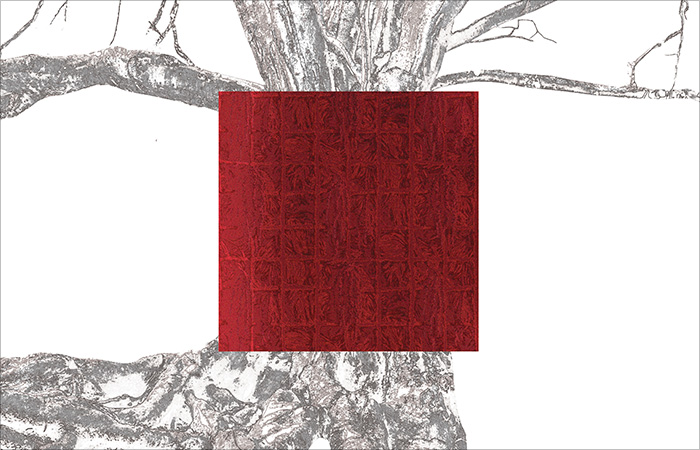
Further into the space, a red cage appears. It is large, close to the scale of the human body, and you feel it in relation to your own. Its structure is strict, repetitive, almost cold, but it has been wrapped, softened, worked through by hand. The red thread changes everything. It gives the structure a density, as if it were carrying something within it, even when it appears empty. The colour is insistent. It brings associations of blood, of interior life, but also of warning, of something that should perhaps not be touched.
There is something excessive here, something that does not settle into a single meaning. It feels both protective and restrictive at the same time. As Julia Kristeva suggests, these are the moments where boundaries begin to blur, where inside and outside are no longer clearly separated.
In another room, a video shows a hand pouring sand into a cage. The gesture repeats. The sand slips through, gathers, disappears, and begins again. Nothing accumulates. Nothing resolves. Over time, the action becomes almost hypnotic, not because it changes, but because it doesn’t. It stays with the same attempt, again and again, to hold something that cannot be held.
Across the exhibition, materials carry a strong presence. Wool, ceramic, sand, glass. They feel familiar, grounded, but are used in ways that shift their meaning. The domestic meets something more visceral. Protection begins to resemble containment.
There is no clear conclusion here. The works remain in an in-between state. They hold things together, but not completely. They leave something open, not fully exposed, but not entirely contained either.