In Transit – exhibition

19 JUNE > 30 AUGUST 2026 I ARMAZÉM DAS ARTES, ALCOBAÇA
Opening on 19 June at 6.30 pm, at the Armazém das Artes venue in Alcobaça, the exhibition Em Trânsito —featuring drawing, painting, illustration, animation and artificial intelligence —and, as its name suggests, Em Trânsito has moved from the Faculty of Fine Arts, where it was on display at the Lagoa Henriques venue between 4 and 27 May 2026.
Organized by:
António Trindade (project author)
Américo Marcelino
Susana Oliveira
Diana Costa
Artists:
Catarina Lira Pereira
Cygny Astra Malvar
Gabriel Colaço
Gilberto Colaço
Isabelle Faria
Joana Mosi
Joana Paraiso
Lúcia Antunes
Nádia Joaquim
Yun Zhang
In transit. Multifaceted conceptual processes under construction.
António Trindade
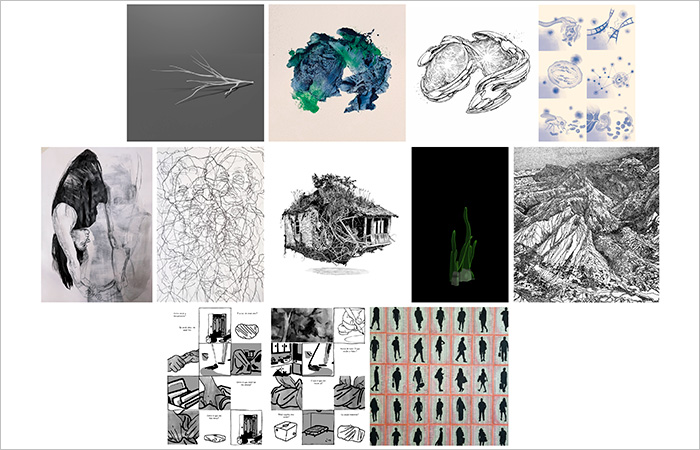
In Transit (Em Trânsito) brings together the theoretical and practical artistic research of ten students on the PhD programme in Fine Arts, specialising in Drawing and Painting. In this exhibition, we can explore a diverse range of research areas, spanning drawing and painting—both analogue and digital—3D modelling, illustration, animation, and integrated visual art, some of which has also been created using AI (artificial intelligence). We observe diverse trajectories in which Drawing and Painting are present, ranging from cultural heritage to their applications and projections in scientific diagrams, in illustration and narrative, in fieldwork centred on risk, drawing on diverse geographies, maps and territories, to the utopia of possible and imaginary territories, striking and alarming, right through to ecological drawing, mapped and animated by the behaviour of plants, carrying a political message in the face of recent climate change and the harmful human behaviour that threatens us today.
Catarina Lira Pereira presents us with works set in juxtaposition that create a sense of tension in the viewer, playing on the interplay between analogue representations in watercolours and the algorithmic drawings derived from them, in which she employs artificial intelligence to juxtapose intriguing and complementary images, thereby establishing an ambiguity between painting and drawing. The series presented by the artist stems from a process inspired by the Rorschach test and explores the transition from the blot to the outline, as if the latter were the crystallisation of the former.
Cygny Malvar has been creating works that explore the possibilities of photography and its expansion and shift towards other forms of representation, in which she employs analogue drawing. In these drawings, centred on Points of View, Proximity and Intimacy, the artist depicts and transforms through drawing the moments captured by photographic records, creating other ambiguous representations where reflection on time, space, memory and affection are an integral part of her conceptual process. This results in representations of immense expressive power, drawing on scenes from everyday life and intimate spaces.
Gabriel Colaço works in partnership with his brother Gilberto Colaço; both have developed an artistic practice characterised by the phenomenology of territory, in which various tools and media are integrated into their conceptual process, making use of new technologies such as 2D drawing, practised by the former, and 3D modelling and printing, practised by the latter. Through this collaboration, they create intriguing objects that stem from a particular questioning and reflection on territorial phenomenology, where a latent tension remains in the observer’s gaze between human interventions and the diverse places of the surrounding, visible natural world, which undergo constant change in space and time according to the metamorphic laws of nature. This results in objects of great visual impact, such as the lithophanes featuring light boxes in which digitally created designs are visible, laser-engraved and equipped with sensors and lighting using LED lamps. In the work of Gabriel and Gilberto Colaço, software, devices and digital interfaces reconfigure the graphic gesture and the materiality of the drawing, where the latter serves as a matrix for volumetric representations and vice versa.
Isabelle Faria, an established artist, as her Curriculum Vitae clearly attests, develops and explores drawing in a dynamic and reflective manner, yet with great expressive power. Movement, action, the act of drawing, and taking risks are all part of her creative process, in which her work unfolds between the surrounding landscape and her studio. The artist undertakes journeys through the long, arid and empty landscapes of southern Spain; these journeys in themselves constitute material that is subsequently worked on in her studio. She employs a highly distinctive conceptual process, metaphorically inspired by the dynamics of a two-wheeled machine’s spool, which allows for forward movement, retreat and pauses, fuelling experimentation, introspection and reflection. This movement, which can move forwards, backwards or even stop, reflects the cyclical and fluid nature of her creative process.
Joana Mosi works in the field of illustration. She has been developing a body of work centred on ‘Urban Space as Experience and Representation in Graphic Narrative’, which forms the basis of her PhD project. The author is interested in the connection between comics and the graphic approach to and representation of urban space. In this regard, her work builds bridges between drawing, architectural thinking and graphic narrative, incorporating questions and reflections on composition, construction and layout. She relates the navigational paths of cities to the composition of reading on a page of illustration.
Joana Paraíso’s work focuses on territory, understood not as a specific geographical area, but rather as a space of lived experiences involving the body, experience, memory, connections and their traces. Territory is thus understood as an inhabited, lived-in place, as a place that is not only visible but also sensory, with precise meanings, in the search for and encounter with the unknown, echoing somewhat what Umberto Eco once referred to in his 1968 work The Absent Structure. Through selected routes, the artist records these memories, lived experiences and encounters, which are then developed and materialised in her studio in a unique and highly original manner.
Lúcia Antunes specialises in scientific illustration, and is currently working on a science visual communication project for the Católica Biomedical Research Centre (CBR), bringing to life her PhD research, From the Invisible to the Visible through Drawing as a Process of Communication between Art and Science. The work proposed for this exhibition features scientific illustrations with a strong visual impact and a high level of detail, created in direct collaboration with the information the artist gathers from other project members and staff at the Catholic University.
Nádia Joaquim presents works centred on drawing that explore themes of grief, panic and melancholy; she is currently working on her PhD project entitled Drawing and Melancholy: Theory, Aesthetics and Cross-Disciplinary Approaches in the Construction of an Artistic Project. Nádia Joaquim’s proposed works have a strong visual impact, resulting from striking, energetic drawing and compositions in which line-drawn figures show overlays of abstract forms with faces suggested by equally energetic lines, creating a sense of great ambiguity for the viewer. As a scholar and researcher of the rich cultural heritage of art history, philosophy and aesthetics, she utilises this knowledge to open up avenues that contribute to the development of her current artistic trajectory, now presenting figurative elements that interact, contrast and overlap with others of a more abstract nature, thus embodying something new still under construction and development, yet with promising results.
Yun Zhang has been developing a highly original body of work featuring images and dynamics that stand out for the quality of their digital drawing, painting and animation, with a strong visual impact evident in the quality of the linework, the colour palette, the contrasts and the movement employed by the artist. Working with artificial intelligence (AI), the artist explores and has been working on the issue of plant cognition, their visualisation, perception and rhythmic representation, championing ecological imagination. The artist and researcher advocates and explores cognition as a distributed and processual structure of living activity, not exclusive to humans, but extending to other beings—in her case, plants—which are forms of a vast organic structure constituting structural nuclei of the organisation of the images themselves. Based on this issue of the decentralisation of cognitive phenomenology, Yun Zhang proposes her own method, the Ecological System of Perceptual Imagery (EPISM), which enables the translation and visualisation of the composition, rhythmic temporality and regulatory mechanisms that generate highly distinctive image systems. The author presents here three works produced within this context, which form an integral part of her broader PhD project entitled Visualising Plant Cognition: Rhythmic Perception and Ecological Imagination in Drawing and Digital Painting.
Lisbon, 17 March 2026
António Trindade.
+ Catalog Texts